What Is Online Search Advertising & How Does It Work?
Online search advertising is a method of placing paid ads on search engine results pages, targeting users based on the keywords they type into search engines like Google or Bing.
Here’s a quick overview of how it works:
- You choose keywords: words or phrases your potential customers are searching for
- You set a bid: the maximum amount you’re willing to pay when someone clicks your ad
- Your ad enters an auction: the search engine ranks ads based on your bid and ad quality
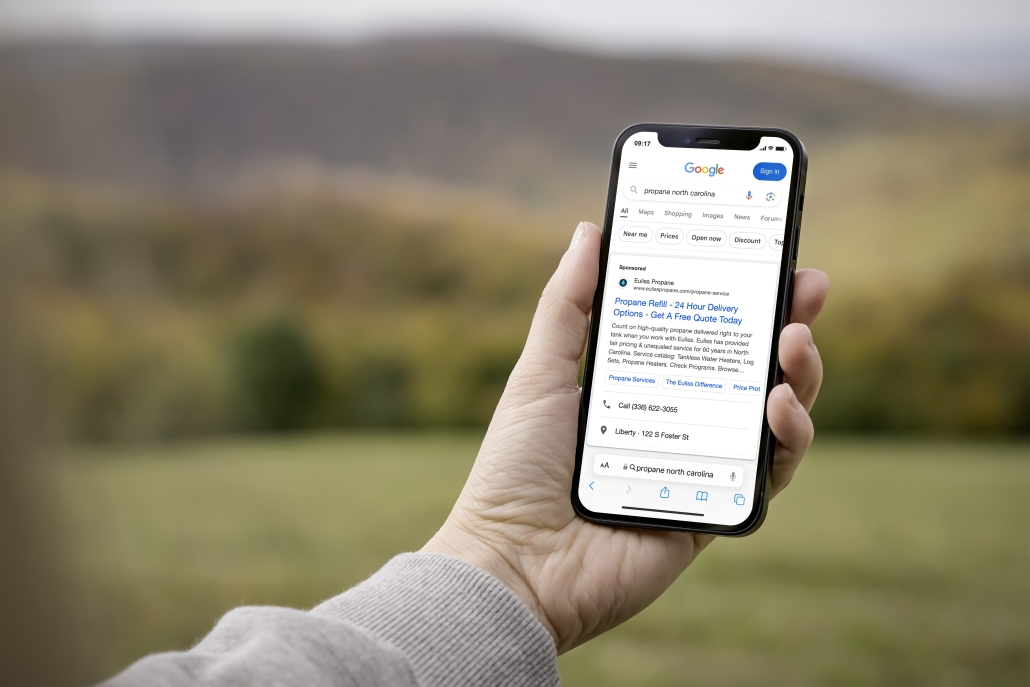
- Your ad appears: shown above or below organic (unpaid) results, labeled as “Sponsored”
- You pay per click: you’re only charged when someone actually clicks your ad
This is fundamentally different from organic search results, which are earned through SEO and ranked by relevance — not paid placement.
Search ads tend to generate significantly higher click-through rates than display ads. Recent industry benchmarks put average search-ad click-through rates above 6%, while display ads typically remain below 1%.
The reason is simple: search ads meet users at the exact moment they’re looking for something. That intent is powerful.
What is Online Search Advertising?
At its core, online search advertising is about visibility and timing. Also known as search engine marketing (SEM) or pay-per-click (PPC) advertising, it is the process of paying search engines to display your business at the top of the search results page.
Unlike organic search, which requires months to climb rankings, search ads offer instant visibility.
Compared to traditional display ads or banner ads that interrupt a user’s browsing experience, search ads are incredibly non-intrusive. They don’t pop up or flash on the screen. Instead, they quietly present themselves as helpful solutions to the questions users are actively asking.
This is a primary reason why click-through rates for search engine ads are so much higher than those of banner ads.
How Online Search Advertising Targets High-Intent Customers
The magic of search advertising lies in capturing explicit intent. When someone searches for “emergency plumber in Harrisonburg” or “best digital marketing in Fredericksburg”, they are not just browsing. They have a specific problem and are actively looking for a solution.
By aligning your ad copy with search queries, you reach consumers at the exact moment of decision in their buying journey.
This makes search advertising far more effective than traditional “spray-and-pray” methods.
How the Search Ad Auction & Ad Rank Work
Every time a user enters a query into a search engine, a lightning-fast auction takes place. The search engine must decide which ads to show, what order to put them in and how much each advertiser will pay for a click. This decision is based on a metric called Ad Rank.
Ad Rank is not determined by your bid alone. Google also considers the quality of your ad and landing page, Ad Rank thresholds, the competitiveness of the auction, the context of the user’s search and the expected impact of your ad assets.
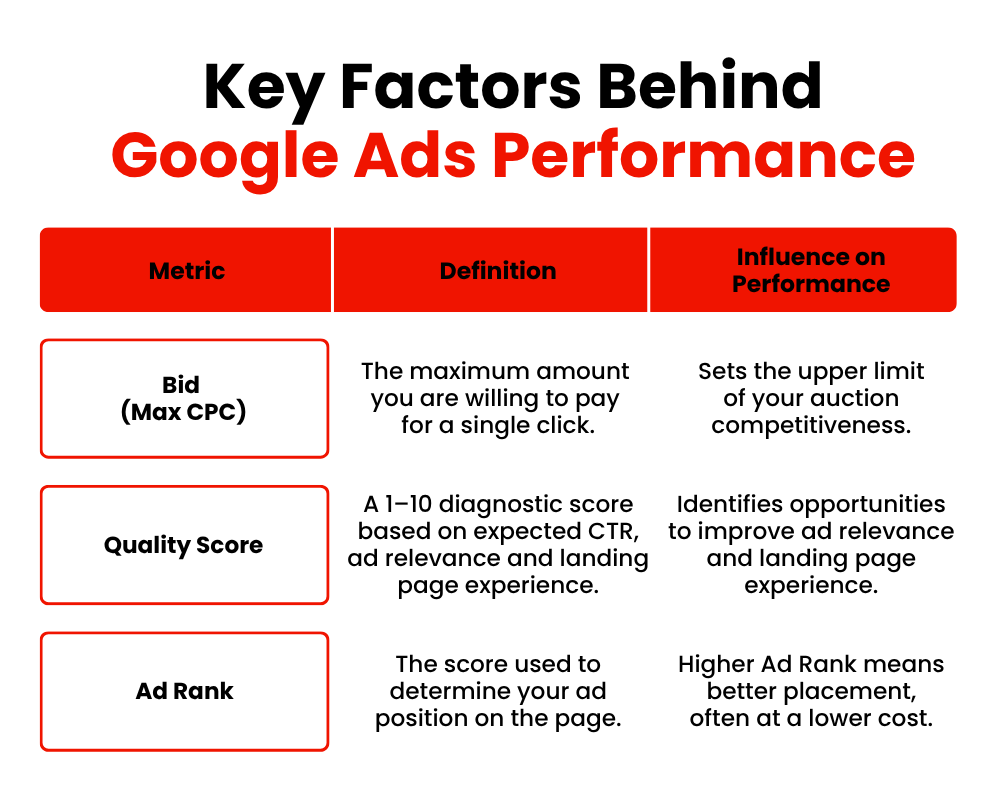
This table outlines three key Google Ads metrics: Bid (Max CPC), Quality Score and Ad Rank. It defines each metric and explains how it can influence campaign competitiveness, ad placement, relevance and overall performance.
Demystifying the Quality Score
Quality Score is a diagnostic tool that helps advertisers understand how their ad quality compares with other advertisers. It evaluates expected click-through rate, ad relevance and landing page experience, helping identify areas where a campaign can improve.
Three main factors influence your Quality Score:
- Expected Click-Through Rate (CTR): How likely the search engine thinks users are to click your ad.
- Ad Relevance: How closely your ad copy matches the intent behind the user’s search query.
- Landing Page Experience: How helpful, fast, transparent and easy to navigate your website is once a user clicks through. If you are targeting users in Augusta County, VA, directing them to a generic homepage instead of a localized, relevant service page will hurt your landing page score.
Understanding Cost-Per-Click Pricing
Search platforms use a modified second-price auction. In most cases, you won’t pay your full maximum bid. Instead, the actual amount you pay is determined by the competitive dynamics of each individual auction and may be lower than your maximum CPC.
This system protects your ad budget and allows for precise cost control. However, without proper campaign management, it’s still easy to waste resources.
Setting Up Your First Search Campaign
When starting, we recommend beginning slowly to test your keyword and ad copy effectiveness before scaling your budget.
- Define Your Goal: Choose whether you want to drive website traffic, generate leads or increase sales.
- Set Your Bidding Strategy: Decide if you want to focus on maximizing clicks, conversions or conversion value.
- Establish a Daily Budget: Start with a comfortable daily limit to monitor performance.
- Configure Location Targeting: Ensure your ads only show where you actually do business. If you operate in Staunton, Reston, Fredericksburg, Winchester or Charlottesville, restrict your targeting to those specific geographic boundaries to avoid paying for irrelevant clicks.
Keyword Strategy & Ad Optimization
Keywords are the foundation of your campaigns. Choosing the right terms and match types determines who sees your ads and how much your clicks will cost.
Mastering Keyword Match Types
Match types tell search engines how closely a user’s search query must match your targeted keyword before your ad can be displayed:
- Broad Match: Offers the widest reach. Your ad can show for searches that relate to your keyword, including synonyms and misspellings. It works best when paired with Smart Bidding.
- Phrase Match: Your ad will show for searches that include the meaning of your keyword. It is designated with quotation marks (e.g., “marketing agency”).
- Exact Match: Gives you the tightest control. Your ad may show for searches that have the same meaning or intent as your keyword, giving you the most control over who sees your ad.
- Negative Keywords: Crucial for cost control. These prevent your ads from showing for unrelated searches. For example, a window installation company would add “software” or “operating system” as negative keywords to avoid paying for clicks from people searching for Microsoft Windows.
Maximizing Performance with Responsive Search Ads
Responsive search ads (RSAs) allow you to enter multiple headlines and descriptions. Over time, the platform’s AI automatically tests different asset combinations to find the best-performing message for each individual search.
According to Google, advertisers who improve their Ad Strength for responsive search ads from “Poor” to “Excellent” see an average of 15% more clicks and conversions. Furthermore, adding a second RSA to an ad group yields a 6.6% increase in conversions, while adding a third results in an additional 3.7% increase.
Frequently Asked Questions About Search Ads
What is the difference between search ads and display ads?
Search ads rely on pull marketing, capturing existing demand by showing text ads to users who are actively searching for a specific term. Display ads rely on push marketing, placing visual banner ads in front of users while they are browsing websites, watching videos or checking email to build brand awareness.
How do negative keywords save ad budgets?
Negative keywords act as a filter, telling the search engine which search terms are irrelevant to your business. By excluding these terms, you prevent your ads from triggering search queries that will never convert, preserving your ad budget for high-intent traffic.
What is Final URL expansion in search campaigns?
Final URL expansion is an AI-powered feature that automatically replaces your static landing page URL with a more relevant landing page from your website, matching the user’s specific search intent. You can read more about how this works and how to set exclusions in the About Final URL expansion in Search documentation.
Turn Search Intent Into Business Growth
Online search advertising is one of the most powerful tools for connecting with customers at their moment of decision. By understanding the auction system, refining your keyword strategy and leveraging AI-driven ad formats, you can drive measurable growth for your business.
Successful search advertising starts with understanding your business, your customers and what they’re searching for. We develop strategies around the right keywords, audiences, locations and messaging, then continually monitor and optimize campaign performance to improve results and make the most of your advertising budget.